Bring Back the Browsing: What Indie Launchers Learned From the Arcade
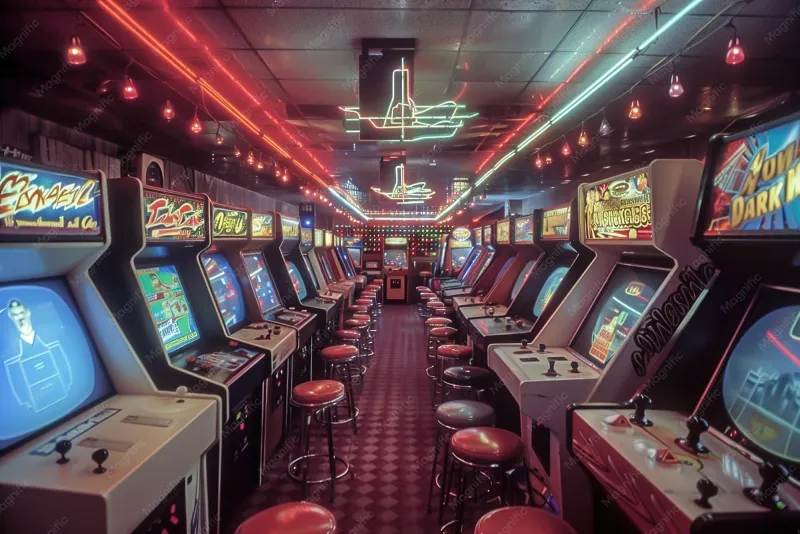
Photo: retro 1980s arcade interior rows of glowing arcade cabinets neon lights, via img.freepik.com
Walk into an arcade in 1985 and you didn't search for anything. You wandered. You saw a cabinet glowing in the back corner, heard a sound effect you didn't recognize, watched someone else's hands do something impossible on the controls, and thought: what is that, and how do I play it?
We've spent twenty years telling ourselves that digital stores made discovery better. I'd argue they made it worse — and that the indie platforms now popping up across the PC gaming scene are quietly proving it.
The Warehouse Problem
Modern storefronts are marvels of logistics and failures of browsing. Tens of thousands of games, sorted by an algorithm whose real job is selling you the thing you already knew you wanted. Search bars, tag filters, and endless 'recommended for you' rows. It's a warehouse with a gift shop sign on the door.
The numbers tell the story. Thousands of games ship on Steam every year now, and the overwhelming majority sell almost nothing — not because they're bad, but because nobody ever saw them. Discovery by algorithm is really just discovery by popularity with extra steps. If your game isn't already winning, the store has no reason to show it.
That's not a shop. That's a slot machine that only pays the house.
What the Arcade Got Right
Here's what the old arcades understood, and what the best indie launchers are now rediscovering: curation is a feature, not a limitation.
An arcade had maybe forty cabinets. Every one of them was chosen, placed, and lit. You could try anything for a quarter. You could watch someone play before you spent anything. And crucially, you were surrounded by other people discovering things at the same time — discovery was social by default.
The new generation of indie-focused platforms — the curated launchers, the storefront-with-a-personality operations — are rebuilding exactly this. Small, hand-picked catalogs. Editorials that read like a friend's recommendation instead of a product page. Bundles that say 'these three games go together' rather than 'here's everything.' Some are adding demo-first browsing, forums, and dev diaries right on the storefront — the modern equivalent of watching over a stranger's shoulder.
Curation Scales Down Beautifully
The counterargument writes itself: curation doesn't scale. True — and that's the point. It's not supposed to serve everyone; it's supposed to serve someone. A warehouse optimizes for the median shopper. A curated store optimizes for a taste, and taste is where passionate spending lives.
We've already seen this movie in other industries. Vinyl shops survived the streaming era by being places, not warehouses. Board game cafés thrived by curating forty games instead of stocking four thousand. The pattern is consistent: when infinite choice becomes the default, the scarce resource is trust — and trust is something a human editor can build and an algorithm can't.
The Future of Game Retail Is a Room, Not a Row
None of this means Steam is going anywhere; the warehouse will keep being the warehouse. But the growth story in PC gaming's next decade probably doesn't belong to the biggest catalog. It belongs to the platform where browsing feels like wandering an arcade floor — where every game was put there on purpose, where you can try before you buy, and where the person next to you is as excited about some weird cabinet in the corner as you are.
The arcades died, but they didn't die because of their model. They died because the hardware got too expensive and the home console got too good. The model was great. Honestly, the model was the best part.
Indie launchers are bringing the model back — minus the quarters.